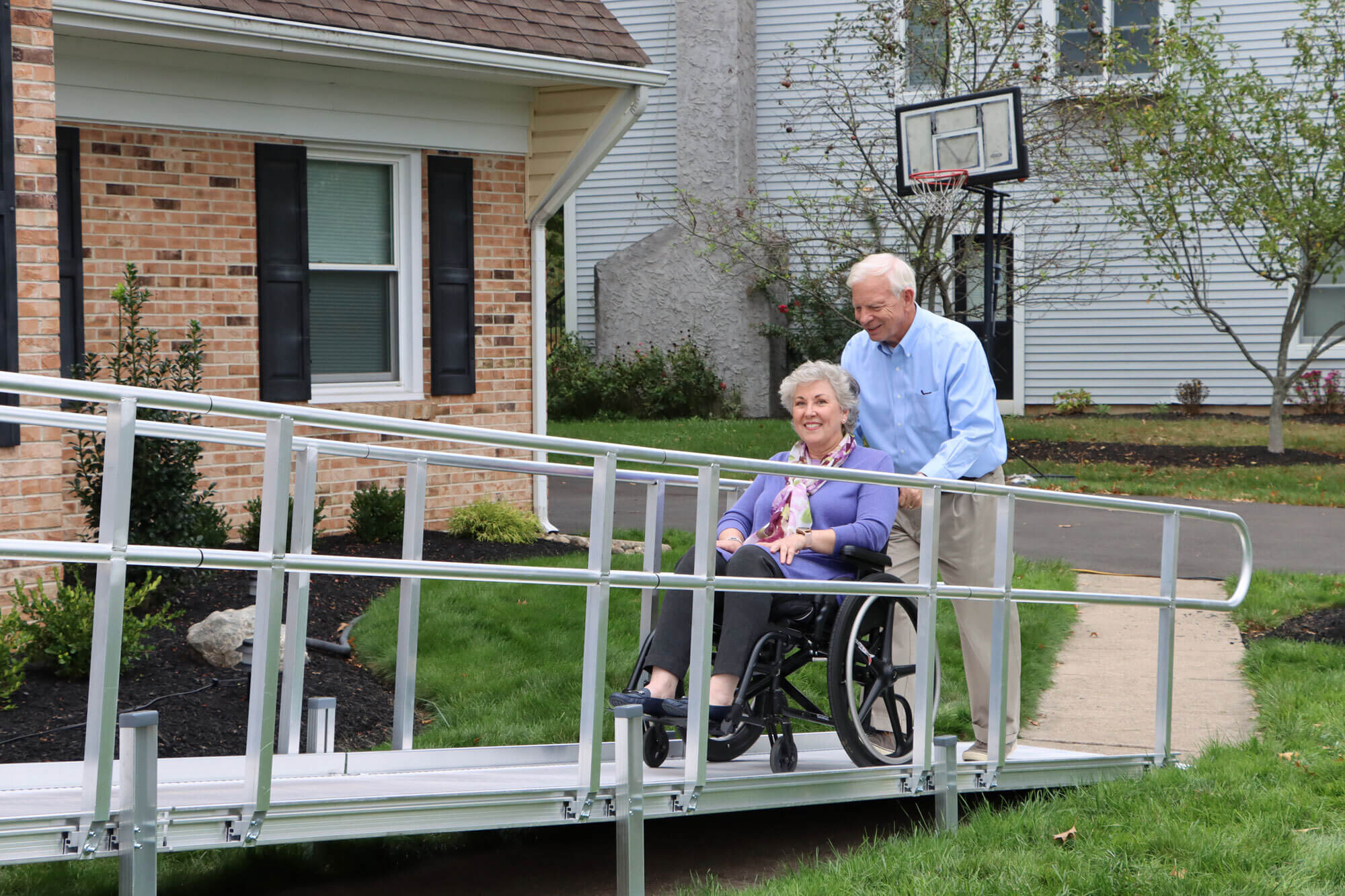
How do you make sure your home access ramp and house are ADA-friendly? It might seem like a daunting task to ensure ADA compliance at home, but with this practical guide, you’ll be well on your way. Before you start, check the guidelines in your area.
Remember: You don’t have to do everything at once! Begin with priority areas like entrances and safety zones, and always ask a contractor or installer who understands ADA standards for help if you’re uncertain about any part of the process.
Access routes and paths
Start by assessing your ADA accessible pathways, access routes, and entry paths. It’s essential to ensure an obstacle-free pathway from your driveway or parking area to your home entrance. Any level change or transition greater than ½ inch should be bridged by a ramp or a gentle slope to make it easier for wheelchair users to cross.
Access ramps and landings
Installing the ramp itself can be a bit more complex. According to the ADA, an access ramp must not exceed a slope of 1:12 (see ADA Guidelines), meaning one unit of vertical rise for every twelve units of horizontal run.
To provide resting points, level landings must be placed at both the top and bottom of the ramp. If the ramp changes direction, a landing should be installed at each turn as well. Each landing must be nearly level, with a maximum tilt of 2% (for every 48 horizontal units, the height may only change by 1 unit). Invest in modular components (ramps, railings) that can be updated or relocated in the future, to keep costs down and flexibility up.
ADA Tip: To prevent wheels from slipping off the ramp edges, install edge protection such as curbs or rails, and use anti-slip mats on the ramp.
Doorways and entries
According to ADA door requirements, accessible doorways must have a clear opening of at least 32 inches, and ideally 36 inches, to accommodate wheelchairs. To make door handles easier to grip and open, install lever-style door handles. Any thresholds should be no higher than ½ inch – use a threshold ramp or bevel the threshold to reduce barriers.
While installing new handles or beveling thresholds can often be done yourself, larger modifications should always be handled by a qualified contractor.
Inside the house
To allow wheelchair users to make full 360-degree turns, key rooms should have at least a five-foot turning radius. Like your outdoor pathways, hallways and corridors should be at least 36 inches wide, though wider is always better for maneuvering and passing.
Flooring also plays an important role. To reduce the risk of falls, choose slip-resistant materials such as textured tiles, matte finishes, or rubberized surfaces, especially in corridors and hallways. Try to avoid thick carpets or area rugs that can obstruct wheelchairs.
Make sure not to forget the bathroom and kitchen, two of the most frequently used spaces in any home. Increase accessibility by installing roll-in showers with grab bars and choosing sinks and counters with adjustable or open-underneath designs.
ADA Tip: Use non-slip surfaces in wet areas and make sure there’s proper drainage to prevent standing water.
Reachability and lighting
One feature many tend to forget about when making their home more accessible are placing switches, outlets, and thermostats where they can be reached from a seated position. A good rule of thumb is placing them 36-48 inches off the floor, and to use rocker or lever switches that are easier to use. Don’t over-complicate things: flexibility, simplicity, and intuitive use are key.
ADA Tip: Install adequate lighting along all accessible routes, both indoors and outdoors, and minimize glare from surfaces to improve visibility and safety.
If you’ve taken all the above into consideration, you’re making great progress toward turning your home into a more ADA-friendly place. Should you want further tips or advice on how to improve on how to improve home accessibility or ADA compliance, contact National Ramp today. Our team is here to answer any questions and make sure your ramp installation meets ADA standards safely and effectively.
Frequently Asked Questions
What makes a home ADA friendly?
A home is ADA-friendly when it provides safe, barrier-free access for people with mobility needs. This includes wide pathways, smooth transitions, accessible entrances, reachable controls, good lighting, and safe, usable spaces throughout the house.
What are the key ramp requirements at home?
The main requirements are a maximum slope of 1:12, level landings at the top and bottom, slip-resistant surfaces, edge protection, and enough width for safe wheelchair use. Any turns must also include a landing.
What home features help with ADA access?
Helpful features include wider doorways, lever handles, slip-resistant flooring, roll-in showers, accessible sinks, reachable switches and outlets, and clear, well-lit pathways both indoors and outdoors.
Don’t Risk Injury To You Or A Loved One
Why wait? Give us a call at 877-596-7293 or contact us online to get started!